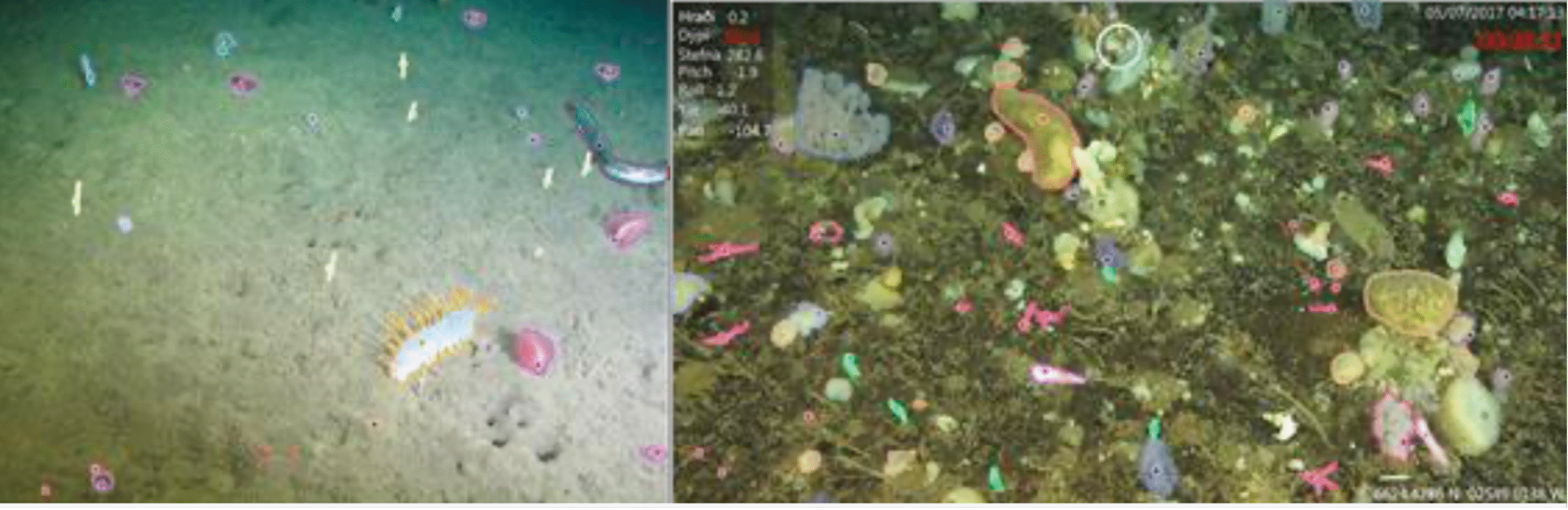
The automated marine image annotation tool speeds up the analysis of seafloor imagery by turning simple point annotations into polygons that can train modern object‑detection models. It sits within the BIIGLE 2.0 platform and supports large scale benthic biodiversity monitoring.
Progress so far
In months 1–18, the project team designed and implemented a semi‑automated annotation pipeline inside BIIGLE 2.0, focused on converting legacy point annotations into high quality polygons.
Key work included:
- Developing a custom parser to ingest historical annotation datasets from the Icelandic demonstration site, covering 3,103 images and 3,831 point annotations.
- Building a point‑to‑polygon conversion module combining tailored heuristics with the Segment Anything Model (SAM) to deal with challenges such as variable object size, thin organisms and dense scenes.
- Running an initial validation phase that successfully converted 93% of the legacy points into polygons and initiating expert review of those polygons with project partners at MFRI.
The team also analysed label inconsistencies, image heterogeneity and conversion difficulties, and agreed to focus initial refinement on sparser images to stabilise model performance.
What this delivered
By M18, these activities produced the first prototype of a scalable annotation pipeline that can dramatically reduce expert time spent on drawing polygons. The tool is currently at TRL 4–5 and already integrated into BIIGLE 2.0, with export formats compatible with global biodiversity databases such as OBIS and GBIF.
Next steps
The next phase will curate the label scheme, train preliminary detectors, and run iterative human‑in‑the‑loop cycles, where experts validte machine‑generated annotations using BIIGLE’s LARGO tool. This will lead to a refined detector with documented performance and limitations, ready for wider use across BioProtect imagery streams..